Assistant Brewmaster Bella

My trusty assistant

It was a brewing emergency – we had a scant two weeks before some beer-loving guests arrived to spend the weekend at the compound, and our kegs were running critically low! I checked the weather forecast and saw a week of rain – except for Wednesday. Wednesday was forecast to have cloudless skies and plenty of sunshine, an outlier in an otherwise crappy week. I quickly arranged to take the day off of work, grabbed the Assistant Brewmaster Bella, and set out to brew up some witbier.

I’m a big fan of witbiers – they are nice and refreshing on a hot day and are also great bridge beers you can use to expose your macroswill-chugging friends to craft beer without scaring them off. There’s a delicate balance that makes this a challenging brew to pull off correctly. The beer is supposed to have a touch of sweetness (usually present as honey or vanilla notes), moderate citrus fruitiness, some spicy, peppery notes, and a very slight lactic bite in the finish. If any one of these flavors becomes too dominant, the beer will lose the refreshing crispness that wits are known for. Witbiers should also have a somewhat creamy, smooth mouthfeel from the use of wheat and oats in the mash.

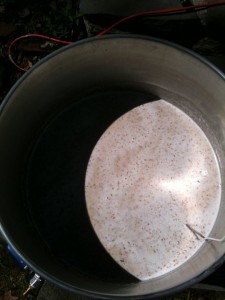
Mashing in the kettle

Mashing in the kettle


The recipe I used called for:

  • 5.5# of Pils malt
  • 5# flaked wheat
  • 2# flaked oats
  • 0.25# Munich malt
  • 1.2oz Hallertau hops @ 60 min
  • 43g citrus zest
  • 11g cracked coriander seeds
  • 1g dried chamomile flowers

You don’t need to grind flaked wheat and oats, but I threw them in the mill because I’ve heard of slight increases in efficiency when doing so. I mashed in my kettle, since this was a step mash and it’s much easier to do those with direct heat. I used a protein rest at around 124°F for 20 min or so and then brought the temp up to 158°F. The problem with mashing in my kettle is that it loses heat very quickly. I had to fire the burner several times over the mash to keep the temp up, and in reality it fluctuated anywhere between 160°F and 153°F. It spent the bulk of the time in the 156-159°F range, so hopefully there will be no ill effects on the finished product.

I tried a new technique this time – iodine testing for starch conversion. Basically, you buy a bottle of tincture of iodine (available at any pharmacy) and use it to test your mash. Extract a small sample of mash liquid (there should be no grain particles in the sample) in a bowl or something and add a drop of iodine – if it turns black, conversion is not complete. If it stays tan/reddish, you are good to go. My recipe called for a 90 minute mash due to all of the wheat and oats, but testing at 60 minutes showed conversion was done so I mashed out at 168°F. I then added about a half pound of rice hulls to help avoid a stuck sparge.

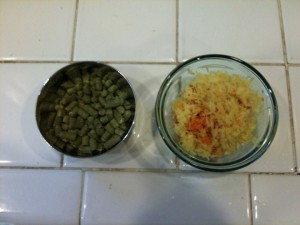
Hops and zest

Hallertau hops and citrus zest

I nailed my pre-boil target exactly – 7G of wort @ 1.042 SG. The rest of the brew went very well, except for one mistake – I miscalculated my evaporation rate. I had been doing 60 minute boils and forgot to compensate for the fact that I was using a 90 minute boil for this recipe. Stupid mistake, and I paid the price. What should have been 5.5G of 1.050 SG wort turned out to be ~4.75G of 1.069 SG wort!!

Well…I made two mistakes here. First was not compensating properly for the longer boil. Second was not testing the gravity during the boil. If I had been keeping an eye on things, I could have added water or reduced the boil time to compensate. However, if I’m going to miss on gravity, I always prefer missing to the upside. When my beers miss high, I just throw the “imperial” tag on them and call it a day!

Highlight of the brewday had to be the last five minutes of the boil, when I added in the citrus zest, the chamomile, and the coriander – the wort smelled amazing! I didn’ have time to make a yeast starter for this brew, so I pitched two packs of Wyeast 3944 (Belgian Witbier). Not very cost effective, but the right thing to do in the absence of a proper starter.

All in all, it was a good day and a good brew – I just hope the higher alcohol content doesn’t wreck the balance of the beer. I’ll keep you posted!

So, last time I posted here (ahem…cough…almosttwomonthsago!… cough cough) I spoke of rushing a beer and going from grain to glass in one week. Well, the experiment was a smashing success! I decided to go with a nice American wheat flavored with some boysenberry extract.

The beer was definitely green, but it was surprisingly drinkable. I told everyone at the Fourth of July gala that it was an experimental brew, so I figured people would stay away from it. Boy, was I wrong! I heard from several people that this beer was their favorite of the three (the others being an IPA and a Kölsch), and it was the clear favorite of the ladies. So, brewers, never again let your procrastination and poor time-management skills stop you from your mission!

In other news, I have finally decided to change the name of this blog to something more beer specific. Coming this fall, I will be re-launching the site at BrewBrewDrink.com. This dovetails nicely with some other beer-related programming projects/websites I am working on, and I’ll have more news on those as they develop over the coming months.

Finally, I wanted to give a shout out to another Connecticut brewer I had the pleasure of meeting recently. My friend Jeff and I were able to spend a great Saturday assisting Brewmaster Dan of Two Beagles Brewing with a batch of American Pale Ale. Dan is an extremely knowledgeable brewer and a great host, and I was able to see the Sabco Brew-Magic in action. I’ve been considering upgrading to a system like this for awhile, and this brought me one step closer to pulling the trigger. It was great to watch another brewer in action, and I was able to pick up a lot of tips and tricks I’ll be applying to my own process. Many thanks to Dan for his hospitality, and the great Vienna Lager and Maibock he allowed us to taste!

Alarm clockAfter several very busy weekends, I find myself a couple of kegs short of my July 4th weekend party goal. The party was supposed to feature four styles of beer, which I knew was an ambitious plan. I should be happy I have two styles ready to go – the American IPA I brewed in late May, and a batch of Kölsch brewed a couple of weekends ago which is ready to be kegged.

Most brewers would hang up their mash paddle and enjoy the party, happy to be able to serve 10 gallons of good brew instead of the usual backyard BBQ crappy macroswill. Especially considering that there is still a plethora of party details to take care of in the next week and a half, including a fairly involved food menu. However, I am not like most brewers – I am completely insane. I’m considering trying to go from grain to glass in one week.

Many a brewer has tried to rush a beer along to try and meet some competition or party deadline. Most of the time, the results are disastrous. The dance of yeast and malt is a fickle one, and trying to force the beer to bend to your schedule can lead to a host of issues. Hot fusel alcohol notes from high-temp turbo fermentations, CO2 bite from rushing a forced carbonation (natural carbonation isn’t even an option on this schedule!), and overall green-tasting beer are just a few of the perils that await an impatient brewer.

I do, however, think it can be done. Let’s talk about some assumptions.

Assumption 1: You aren’t doing this with any kind of complex beer. Forget anything with an OG above 1.040 or so. Forget your dry-hopping, your nine-malt grain bills, your oak chips, your bourbon infusions, all of that. We have to go fast here, and any kind of complexity is going to need time to mellow and allow flavors to meld.

Chris Hansen

"Put down that Hefe and have a seat over here"

Assumption 2: Forget any kind of aging/conditioning process. If we had time to lager this beer, we wouldn’t be in this situation. So we need ales that are best enjoyed young. I mean really young. I mean, if these beers were people, you’d have Chris Hansen getting all To Catch a Predator on your ass. A few styles instantly come to mind – witbiers, hefeweizens, English milds, American wheats – all best served at the peak of freshness.

Assumption 3: We need a fast and furious fermentation, but without sacrificing the beer quality by going too hot. Hefeweizen yeast can ferment at higher temps, but I still try and keep things on the cool side to keep the banana esters from becoming too overpowering. Saison is another style that can be fermented on the warm side, but I think it might have too complex a flavor profile to meet our first assumption. So, if we can’t ferment hot, how else can we speed up the process?

Assumption 3a: We are going to need a lot of yeast. This means either using a yeast cake or making a very large starter. You want the yeast to hit the ground running and not waste a single precious moment.

Assumption 3b: We want to use wheat, which is known for extremely active and fast fermentations. Wheat beers offer another advantage as well – they are usually meant to be served with yeast in suspension, meaning we don’t have to worry about filtering or wasting precious time trying to get the beer to drop clear.

OK – so now that we have some ground rules, it’s time to figure out exactly what to brew. This beer will be served next to an IPA and a Kölsch, so I want its flavor profile to be somewhere in the middle. I’m going to use the yeast cake from the Kölsch, so a true hefe is out. That leaves me with a witbier, with its coriander and citrus tang, or an American wheat, which I would probably add some sort of fruit extract to. I plan on fermentation being done by day three or four, leaving me some time to get the beer kegged and carbed in time for the party.

I’ll be making my final decision over the next couple of days, and plan to brew this puppy in a late-night session after work on Friday. I’ll keep you posted.

Old beer cansI opened up the chest freezer I use as a serving fridge, not really knowing what to expect. It had been almost a year since I had poured any homebrew, and I figured the inside of the freezer would be a mess, full of nasty, empty kegs and some kind of mold/slime combination. I wasn’t looking forward to the cleaning job that surely awaited me.
Imagine my surprise when I discovered a nice, clean interior stocked with three almost-full kegs of beer, and a bottle of champagne to boot! The freezer had been held at a steady 40°F the entire time, and the kegs were all pressurized. Only one question remained – was the beer still drinkable??

It looked like I had about 7 or 8 gallons of a pumpkin spice I had brewed (which had turned out a bit more “imperial” than I had intended) and around 4 gallons of the Kölsch I brewed last August. I poured a few pints, called the wife over, and proceeded to hope for the best…

…and it was good!! All the beer was excellent! The carbonation levels could use some adjustment, but the pumpkin spice ale had mellowed nicely, and the Kölsch didn’t have any off-flavors to speak of! This was great news, since I worry so much about sanitation and the longevity of my beers. I’d love to brew up some special Belgians or barleywines and cellar them for a few years, and this gives me a boost of confidence that my procedures are pretty sound and I might be able to pull that off.

Now, I’m left with a problem I don’t mind having – how to dispose of many gallons of tasty homebrew to make room for many more gallons of tasty homebrew?

Sounds like a party to me!

Sometimes you just nail it.

Last weekend’s IPA brewday was one of my best ones yet. All of the water volume data I recorded last year finally paid off big time – my original gravity came in at 1.072 vs an expected 1.071 – my most accurate brew to date! It wasn’t perfect – my mash efficiency came in 5% low (75% vs the expected 80%), and I was still about a half gallon of wort short at the end (5.5 gallons into the fermentor instead of 6) – but the errors were small and effectively cancelled themselves out. Sometimes the brewing gods smile upon you and two wrongs do make a right!

Fresh hops

All of the data I took last year was very helpful in estimating my grain absorption and evaporation rates and tun, kettle and cooling losses. My new water meter made measuring water a snap, and I decided to round all measurements to the quarter gallon. This took a lot of the micro-management out of the water side of things, and I’m very pleased with the results. This was my goal all along – the meticulous collection of data leading to the ability to relax and enjoy the results.

The IPA has been gurgling happily in my fermentation fridge at around 65°F – my basement is actually cooler than that, so I’m using this brewing space heater with a dual stage controller. It’s actually a flat pad you can stick to the wall of the fridge – perfect for maintaining ale temps in a cool basement or during the winter.

Today was the first gravity reading and taste test. The gravity is currently at 1.020 vs an expected final of 1.017, so it has a few more days before I crash cool it. The taste – all I can say is WOW! This is one nice IPA, even when it’s warm and flat! It has a really fragrant hop nose and you think it’s going to clobber you, but with its high starting gravity it comes out very well-balanced. Not too thick of a mouthfeel, a nice, strong malt backbone, and sharp, citrusy hop flavor cutting through it all. Even my wife loved it, and she is not a hophead at all.

You can find the recipe here. Also, I’m looking for a name for this beer – any ideas? Leave a comment or hit me up on Twitter.

The biggest problem I’ve had to date with my brew system is water management. When you do partial boils, this problem never rears its head – you brew a few gallons of wort and just top off with water to get to your final volume. Easy peasy. When you start doing all grain mashes and full boils, however, you need to back into the amount of water to use, taking all sorts of factors into consideration. What is your evaporation rate during the boil? How much water does your grain absorb? What about cooling losses, liquid left in tubes, and deadspaces in kettles and tuns? It’s enough to drive a man mad.

Last year I focused on trying to pin down my exact water usage. First I tried using dipsticks. Then I tried weighing the water. I used various pitchers and containers to measure but the end result was always the same – small inaccuracies in my measurement methods would add up and I would end up missing my targets completely. The only thing consistent about my brewing setup was its inconsistency.

However, all of this data I gathered did help me find a pretty narrow range for things like grain absorption and evaporation rates. I was getting very close to the answer – now I just needed an accurate way of measuring the water.

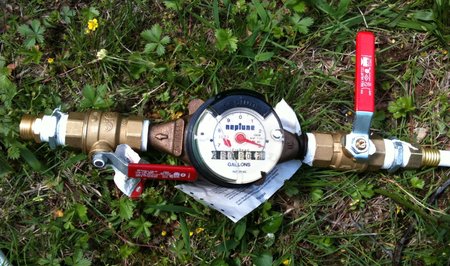
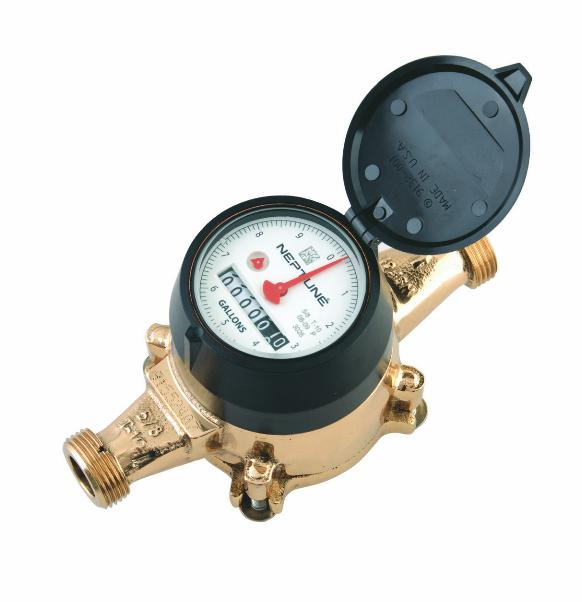
Neptune T-10 water meter

Neptune T-10 water meter


Meet the Neptune T-10 residential water meter. The T-10 is supposedly optimized for accuracy during low-flow situations, which made it a perfect choice for my brewing applications. I picked this bad boy up from eBay last year, and finally got a chance to hook it up and give it a whirl. The goal was to find a way to hook up the T-10 to my hose spigot in the backyard. If this worked, I would have a way to measure the water I was adding to the system without having to use pitchers, scales, or (insert other time-consuming and frustrating methods here).

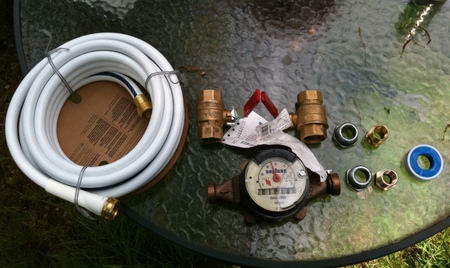
I ran off to a large, orange hardware store to look for the fittings I needed. It took two plumbing guys and about 30 minutes to find something that would fit the T-10 – the first few adapters they picked out didn’t seem to thread properly. I finally walked out with two 1″ ball valves, two 1″ to 3/4″ bushings (luckily, I noticed they picked out black pipe and swapped them out for galvanized – black pipe shouldn’t be used for drinking water applications), two garden hose adapters, and a white camper hose rated for potable water.

Fittings for the T-10 water meter

Fittings for the T-10 water meter


I applied a generous wrapping of teflon tape, screwed everything together, and hooked it up to the spigot. Much to my surprise, this Frankenmeter actually worked! I was able to measure out my strike and sparge water in a fraction of the time it used to take me, and some quick tests with a half gallon pitcher showed the accuracy was good enough for my purposes. The only complaint I have is that the odometer-style gauge on the front (which measures 10s of gallons) obscures part of the clock-style gauge that runs around the face of the meter (which measures fractional gallons, and is what I use). A Sharpie and ruler should remedy this easily enough, but it would be nice if I didn’t have to do that.

All hail mighty Neptune!

All hail mighty Neptune!


I view this experiment as a success – not only will the Neptune help me achieve greater accuracy in my measurements, but it is also going to save me a significant amount of time each brewday. It wasn’t cheap ($40 for the meter and $40 for the fittings, although I really only needed one ball valve) but the benefits definitely outweigh the costs.

Image of many bags of brewing hops

No, not a drug bust...just inventory day

After suffering through the ridiculously harsh winter we just experienced, I am officially opening the 2011 brew season – better late than never. Following an absence from brewing, I have some rituals I go through to get back on track. I go over notes from my last few brews to see what issues I was trying to deal with. I clean my equipment and replace anything that is past its useful life. And I update my inventory.

That last one is a pain. Last year, I accumulated a lot of ingredients I didn’t get a chance to use. I prefer to use fresh ingredients, but as long as the grain has been stored dry and the hops haven’t left the freezer, I figure they’re good to go. I might make an exception when brewing a really delicate style, but since I haven’t gotten into lagers yet, that hasn’t been an issue.

So, I broke out the scale and notebook and spent an hour or so recording what I have on hand. Here, without further ado, is the starting lineup of the 2011 season:

Grain

Ingredient Quantity
Aromatic malt 1.00#
Black Patent malt 0.50#
Crystal 20L malt 2.00#
Crystal 40L malt 3.00#
Crystal 60L malt 1.75#
Crystal 120L malt 1.00#
Chocolate malt 2.00#
Halcyon 2-row pale malt (UK) 44.50#
Munich malt 6.75#
Pale Chocolate malt 1.25#
Pilsner malt (Germany) 22.00#
Special B malt 1.00#
Special Roast malt 1.50#
Victory malt 1.50#
Vienna malt 4.00#
Wheat malt (Germany) 15.00#
White Wheat malt 0.25#
Hops

Ingredient Quantity
Amarillo hops 2.00oz
Cascade hops 4.00oz
Centennial hops 2.00oz
Chinook hops 2.00oz
Citra hops 2.00oz
Cluster hops 2.00oz
Columbus hops 4.00oz
Fuggles hops (whole leaf) 5.00oz
East Kent Goldings hops 1.25oz
Hallertauer Mittelfrueh hops 4.00oz
Magnum hops 2.00oz
Mt. Hood hops 2.00oz
Northern Brewer hops 6.50oz
Pearle hops 3.00oz
Saaz hops 3.00oz
Tettnang hops 8.00oz
Vanguard hops 1.00oz

There you have it – 114.75 pounds of grain and 53.75 ounces of hops. That’s certainly enough to keep me busy. Let’s hear some recipes to help me get rid of this overstock!

My first hydrometerWell, it was bound to happen eventually.

That picture is of my very first (and only) hydrometer. I got that in the starter kit I bought over five years ago, when I began this long and crazy descent into brewing madness. Over the years, I’ve treated this thing with kid gloves – especially as the time and brew sessions kept adding up. “How cool would it be,” I mused, “to still have that original hydrometer, that connection to my humble beginnings, forever?”

I had planned to eventually retire it, perhaps mount it and hang it over that bar I’m going to build one day. I daydreamed about its last task being the measurement of my first professional wort’s gravity. It served me very well throughout the years, and today, it is no more.

My dear wife accidentally dropped it today when she was helping me clean up some of my brew gear. She feels horrible about it – she knows how much that hydrometer meant to me – and she’s keeping the pieces to make some sort of tribute or memorial to my trusty friend. Perhaps it will still find its rightful place in my personal brewing museum, as time keeps marching on and I try and make this less of a hobby and more of a profession.

However, as I think about it, I can’t be that sad. After all, it’s just a hydrometer – an easily replaceable tool, and one which I have been considering replacing with a refractometer for some time now anyway. When I stop and think about what’s really valuable, what’s been with me since the very beginnings of my brewing journey and what has always encouraged and supported this passion of mine, it’s my wife.

She took me to my first brewery tour at Harpoon in Boston, and we brewed our first beer together. She came with me to pick up the kit, to learn how to use that tricky hydrometer for the first time, and to drink that brew which was the best beer I’d ever had because I had made it myself. And she has put up with the never-ending array of gadgets, freezers, buckets, and CO2 tanks which have taken over our home. She encourages and inspires me, and I truly think that helps me brew better beer more than any tool could.

So, rest in peace, hydrometer. You served me well, and you will not be forgotten. I raise a glass to you tonight – to brews of the past, and the brews of the future you will not be there to measure. However, I shall not be sad, for I still have the really important things in life, and to lose sight of that would be the real tragedy here.

The flags of Köln and DeutschlandThe good news: I now have ten gallons of Kölsch fermenting in my chest freezer (which just BARELY fits two 6.5G plastic buckets inside).

The bad news: In brewing my first 10G batch, I completely botched my water measurements and had a generally sloppy brewday.

OK, so the good news outweighs the bad news – assuming the beer turns out well! I’m glad I was able to rumble through the day and finish with two fermentors full of beer, but I’m mad at myself for fudging my processes…I know, relax, don’t worry, have a homebrew, right?

I measured the water into my mashtun by weighing it, like I have for the last two brews, in an attempt to pinpoint losses and grain absorbtion rates in my system. My big mistake was not weighing the wort runoff – I figured I could estimate the volume based on how many times I filled the 1/2 gallon pitcher I use, but later found out that pitcher is not exactly accurate and holds a bit more than I thought. I can’t say why I chose not to weigh the runoff, but I think it was a mix of laziness and impatience. I’m kicking myself now.

Long story short, I wound up with 15.3G of wort (which I thought was 14.4G). I was quite confused when my 15G kettle wouldn’t hold all the runoff – I figured I had a smaller kettle than I thought I did. Looking back on my notes today and inspecting the pitcher, it became clear that estimating the runoff volume was a huge mistake.

Just to kick a brewer when he’s down, my pump decided to be a pain in the ass, and my pellet hops turned into a solid sludge at the bottom of the kettle, completely blocking my bazooka screen when I was pumping to the fermentors. I’ve never seen pellet hops clump up like that – it was a pretty solid mass! Not sure if that was a result of whirlpooling while chilling or the specific pellets I used (they were Hallertauer, for what it’s worth). I think I’m going to use a hop bag next time.

So, it was a rough session and all my numbers for this brew are a bit fuzzy, but I’m not going to stress about it. I didn’t miss my OG by much, and the beer should turn out just fine. I just wish I could finally reach the nirvana which is truly knowing my system and hitting my numbers every time. For the next session, I will weigh both water in and wort out of the mashtun, and I will make a dipstick to measure kettle volume before and after the boil. There are a lot of variables to pin down, but I hope being overly precise now will give me the data to churn out consistently great beer down the line. I need repeatability, and I will not allow myself to build or buy an automated brew system until I can get this right manually. It’s a frustrating endeavor, but I will get it one of these days…

…and hey, no matter what, I have TWO buckets of beer happily bubbling away!

In trying to decide what my next brew should be, I contemplated many styles. A pumpkin spice ale is definitely on the list, but I want to wait a few weeks until pumpkins are available before attempting that one. I’d love to do another stout, but I’d rather schedule that for colder weather. I need to make another couple batches of my steam beer, which is my flagship house beer, but I can whip that up anytime and I want to try something new.

Enter the Kölsch. I’ve wanted to brew one of these ever since tasting them in Köln, but never got around to it for whatever reason. I think in the back of my mind I associated them with true lagers, and didn’t want to deal with the huge yeast starter and conditioning times. This style is sort of a hybrid in that it ferments at low ale temperatures, but is best with at least four weeks of lagering after primary – not to worry, though, because at my house, lagering is best conducted with pint-sized samples taken every evening.

So, it’s time. I even have stanges for proper serving and everything. I smacked two very old (two years!) Wyeast 2565 smack packs today, and am picking up two more fresh packs this evening. I plan on making a gallon starter with one fresh and two old packs tonight, and pitching that into a 10 gallon batch brewed on Sunday. I’ll keep the second fresh pack in case of stalled fermentation, or for the next batch.

The recipe is going to be 95% German pilsner malt and 5% Vienna, with light Hallertau hopping. The mash will be low (149°F) and long (90 minutes) with a 90 minute boil. This will be my first 10 gallon batch, and the wort will be split into two primaries and fermented at 60°F. I’ll post an exact recipe once I work out the details in BeerSmith.

© 2011 lootcorp - a brewing blog Suffusion theme by Sayontan Sinha

Bad Behavior has blocked 265 access attempts in the last 7 days.